You spend several hours a day working at a computer. By the evening, your neck, shoulders, or lower back may feel stiff. You want to stretch, move your back, or simply change position.
Sound familiar?
In situations like this, you've probably heard the usual advice: "Sit up straight, pull your shoulders back, and keep your back upright."
But is poor posture really the problem? And can maintaining the perfect sitting position protect you from discomfort?
Let's explore what happens to your body during prolonged sitting, which common beliefs about posture are not supported by research, and what is actually worth changing in your daily routine.
Sitting Does Not Automatically Damage Your Spine
Let's start with something important: the human body is adapted to a variety of positions.
We can sit with an upright back, lean slightly forward, recline against a chair, or change the position of our legs. None of these positions, by itself, is evidence of spinal damage.
The spine is a strong, mobile structure capable of handling a wide range of physical loads.
Scientific research does not support the existence of a single universal posture that is guaranteed to prevent back pain.
However, this does not mean that body position is completely irrelevant. Some positions may feel more comfortable than others, especially when a person is already experiencing pain. The duration of sitting, individual tolerance to physical load, and the ability to change position also matter.
Constantly monitoring every curve of your spine and trying to maintain a perfectly straight back is unnecessary.
A more useful approach is to pay attention to your comfort, change positions regularly, and maintain an adequate level of physical activity.
What Happens to Your Muscles When You Sit for a Long Time?
Your muscles continue working while you sit, but the nature of the load changes.
Some muscles help support the position of your head and torso, others work at a low intensity, and some are barely involved in movement.
This is completely normal. Muscles do not need to remain constantly active.
However, during prolonged sitting, we use a relatively limited range of positions and movements. The hip joints remain flexed for extended periods, the legs move very little, and movements of the spine and shoulder girdle are often limited to small adjustments.
As a result, you may experience stiffness, fatigue, or the urge to stretch.
But it is important to distinguish the feeling of stiffness from an actual reduction in joint mobility.
If moving freely feels difficult immediately after several hours at your desk, it does not necessarily mean that your muscles have become shorter or your joints have lost their normal range of motion.
Mobility is influenced by many factors, including habitual physical activity, muscle strength, the nervous system, tolerance to stretching, and individual anatomical characteristics.
This is why a few minutes of movement after work may help you feel more mobile — not because you have suddenly "lengthened shortened muscles."
The main takeaway is that prolonged sitting limits movement variety throughout the day, but it does not automatically cause muscle damage or irreversible changes.
Why Might Your Neck, Shoulders, and Lower Back Hurt After Work?
Discomfort after prolonged computer work is often attributed entirely to poor posture.
But pain is much more complex than the position of your spine in a photograph.
Several factors may influence how you feel, including the length of time you work without breaks, your overall physical activity, workplace setup, sleep quality, stress, previous episodes of pain, and individual sensitivity to physical loads.
For example, even a relatively comfortable position can become tiring if you maintain it without changing.
A physically active person may cope better with prolonged desk work, not necessarily because they always sit perfectly straight, but because their body is better adapted to a variety of physical demands.
This does not mean ergonomics are useless. An appropriate monitor height, a comfortable chair, and good keyboard positioning may reduce unnecessary strain and make working more comfortable.
However, no chair and no "perfect" posture can completely replace movement.
If you experience pain, do not automatically assume that weak muscles, an abnormal spinal curve, or poor posture are responsible. Pain can have multiple contributing factors, and persistent or worsening symptoms require an individual assessment by a qualified healthcare professional.
Do You Really Need to Sit With a Straight Back All the Time?
Imagine two people working at a computer.
The first constantly monitors their back, tries to keep their shoulders pulled back, and avoids even a slight forward lean.
The second regularly changes position: sitting upright, leaning slightly forward, reclining, and occasionally getting up from the desk.
Which one takes better care of their posture?
Not necessarily the first.
Scientific evidence does not allow us to conclude that one specific spinal position while sitting is guaranteed to protect against pain.
Instead of rigidly controlling every position, it may be more useful to focus on comfort, the task at hand, and the freedom to move.
This does not mean workplace ergonomics are unimportant. Desk height, monitor position, and forearm support can all influence comfort while working.
But even a well-designed workstation does not eliminate the need to change position.
Good posture is not the ability to hold one position for hours, but the ability to use different body positions comfortably.
If a particular position causes discomfort, you can change it. There is no need to tolerate unpleasant sensations simply because a posture looks "correct."
"The best posture is one you can freely change."
How Often Should You Get Up and Move?
One of the most common recommendations for office workers is to stand up every 30 minutes.
But is there a scientifically established interval that works for absolutely everyone?
No. Research suggests that regularly interrupting prolonged sitting with movement can be beneficial. However, a universal frequency and duration of breaks for everyone has not yet been established.
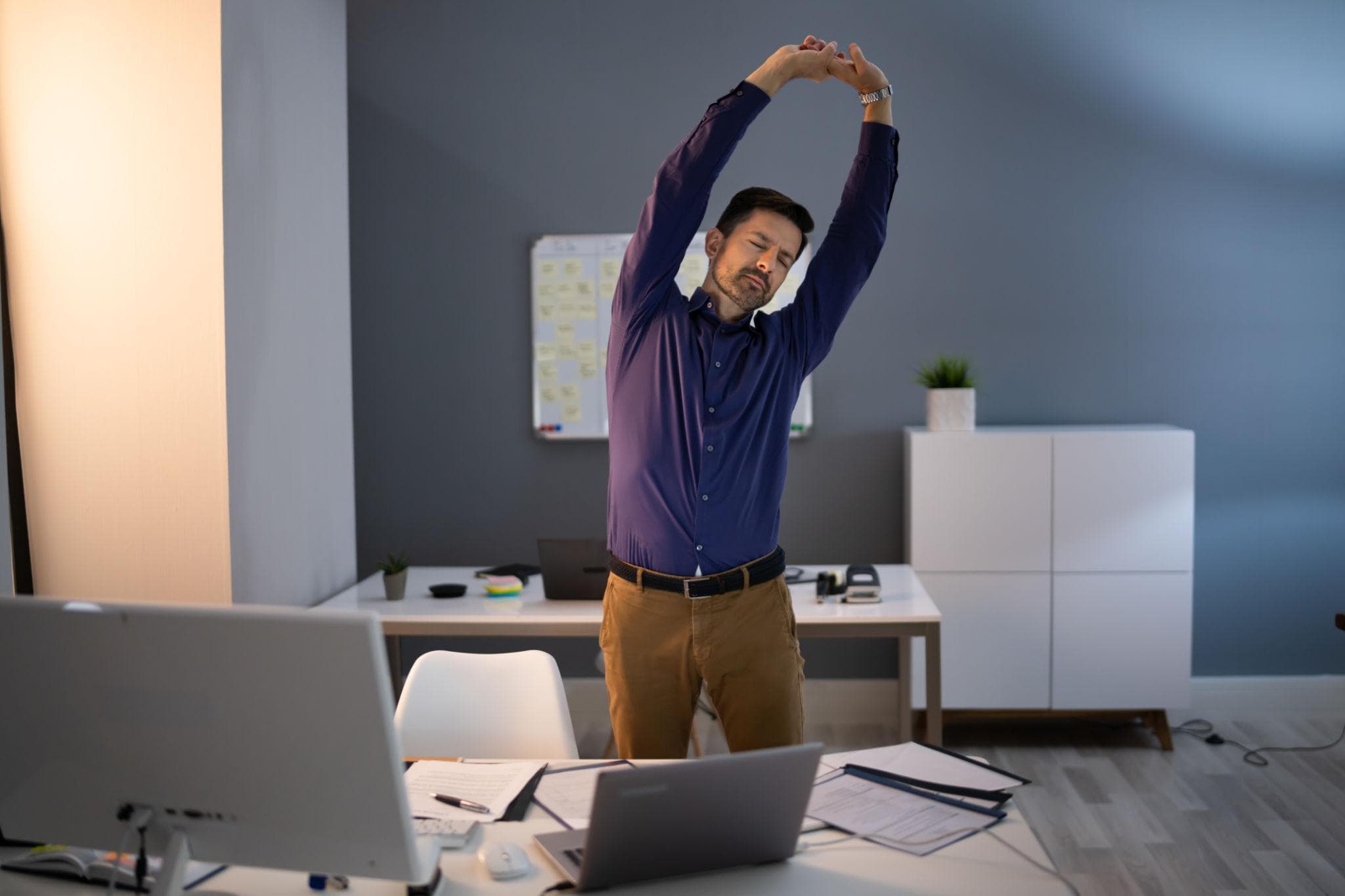
A simple strategy is to stand up, change position, or move around briefly every 30–60 minutes.
This is not a mandatory medical rule, but a practical guideline for organizing your working day.
What can you do in just a few minutes?
- Walk around the room or corridor
- Stand up from your chair and sit down a few times
- Perform gentle shoulder movements
- Extend and rotate your thoracic spine
- Walk around while talking on the phone
- Take the stairs instead of the elevator
You do not need to turn every break into a full workout.
Even short periods of movement can help diversify physical activity and reduce the amount of time spent sitting continuously.
The key is not to find the perfect break schedule, but to make movement a regular part of your day.
5 Simple Movements After Prolonged Sitting
After several hours at your computer, you do not need to perform a complicated workout. Start with simple movements that allow your joints and muscles to work in a wider variety of positions.
1. Cat-Cow — Spinal Flexion and Extension
8–10 smooth repetitions.
This exercise allows you to explore the available range of motion in your spine. Move without jerking and stay within a comfortable range.
2. Thoracic Rotation — Upper Back Rotation
6–8 repetitions per side.
Gentle rotational movements introduce more activity to your thoracic spine. Avoid trying to increase your range of motion through sudden or forceful movements.
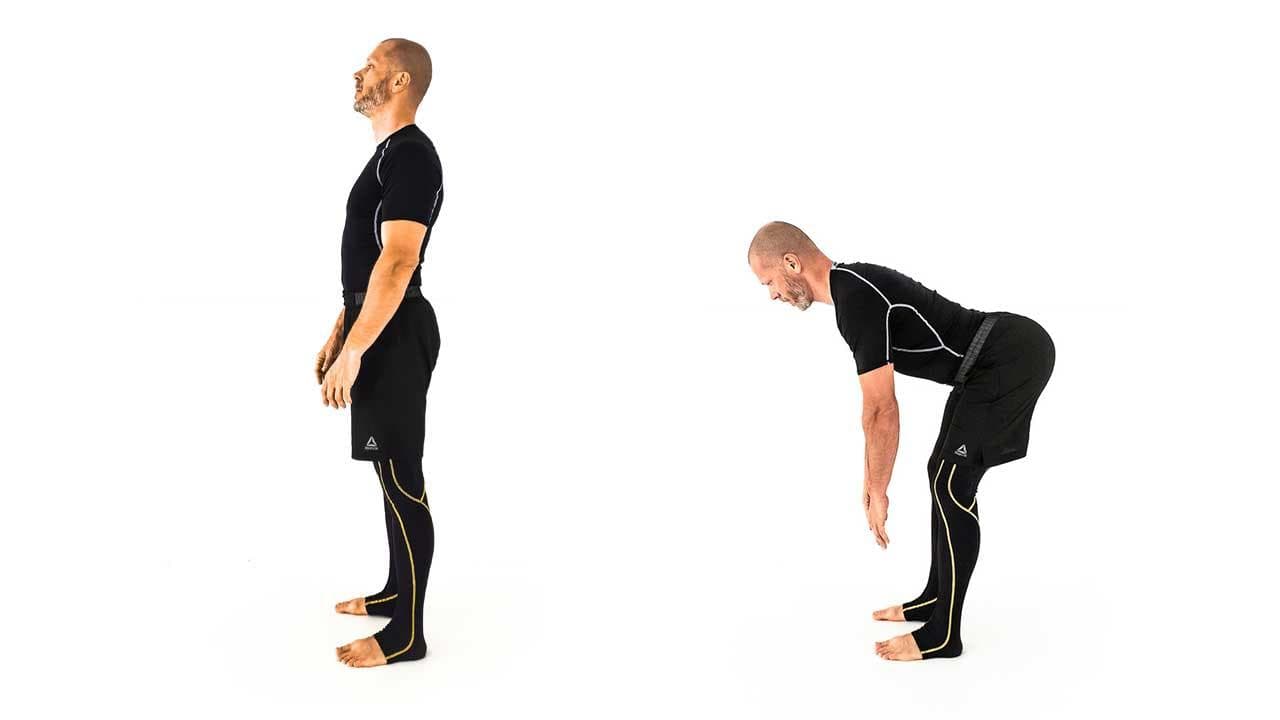
3. Hip Hinge — Bending at the Hips
10 repetitions.
This exercise develops control of pelvic movement and helps distribute movement between your hip joints and torso. Maintain a stable position through your feet.
4. Standing Shoulder CARs — Controlled Shoulder Circles
5–6 circles in each direction.
Move slowly through your available range of motion. Try to maintain control of your torso without compensating through excessive arching of your lower back.
5. Glute Bridge — Hip Extension
10–12 repetitions.
This exercise adds dynamic loading to the muscles responsible for hip extension. Lift your hips with control, without excessively arching your lower back.
These exercises are not guaranteed to eliminate discomfort immediately or "correct" your posture. Their purpose is to introduce a variety of movements and gradually develop body control.
If an exercise causes pain, reduce the range of motion, choose an easier variation, or stop performing it.
For a short break at work, choosing two or three movements is enough. A complete routine is easier to perform at home or during a dedicated exercise session.
Why Is Exercise Important Beyond Taking Breaks?
Regular breaks help reduce the amount of time spent sitting continuously. But they do not replace regular physical activity.
To develop strength, endurance, mobility, and coordination, your body needs a variety of physical challenges.
The World Health Organization recommends that adults perform at least 150–300 minutes of moderate-intensity aerobic activity or 75–150 minutes of vigorous-intensity activity per week, along with muscle-strengthening activities involving major muscle groups on at least two days per week.
However, you do not need to start with a large training volume right away. Even small amounts of physical activity are better than none.
It can be useful to combine several types of training:
- Mobility — active joint movements through an available range of motion
- Strength — exercises using your body weight or additional resistance
- Stability and Control — the ability to manage your body's position during movement
- Aerobic Activity — walking, cycling, swimming, and other suitable activities
This approach helps develop your physical capabilities rather than simply trying to maintain a visually "correct" posture.
The goal of training is not to force your body into one position, but to expand the range of movements and physical demands it can handle.
So What Really Matters for Good Posture?
If you spend a lot of time sitting at work, you do not need to keep reminding yourself: "Straighten your back!"
Instead, try paying attention to a few things.
How much time do you spend without moving? How varied is your physical activity? Do you include exercises to develop strength and mobility? Is your workstation comfortable?
Posture is not a fixed, ideal shape that you need to maintain from morning until evening.
It is your body's ability to adopt different positions and adapt to everyday tasks.
There is no single universal posture that guarantees freedom from pain. However, regular physical activity, a comfortable workstation, and the gradual development of physical capabilities can help you manage everyday demands more effectively.
Do not aim to sit perfectly. Aim to move with greater variety, confidence, and freedom.
"Your body does not need one perfect posture all day. It needs opportunities to move."
Want to Develop Your Mobility and Body Control Step by Step?
If you spend a lot of time working at a computer and want to make regular training part of your life, start with a clear, structured program.
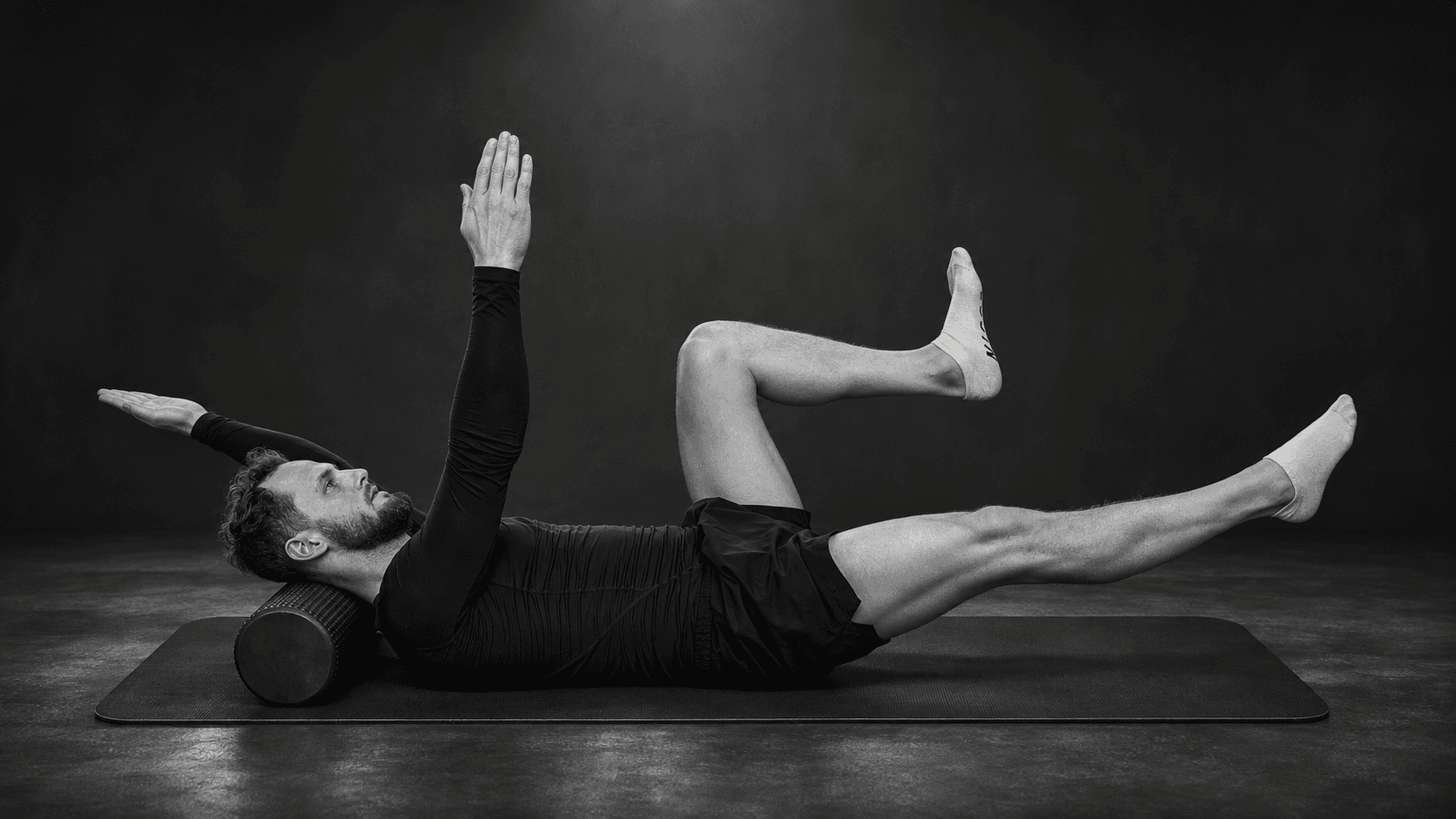
POSTURE RESET — 28 DAYS by Move Better Academy is a four-week training program designed to develop mobility, stability, coordination, and body control.
The program includes 12 short workouts with progressively increasing demands. You will work on movements involving your thoracic spine, shoulder girdle, and hip joints, while strengthening the muscles of your torso.
This is not medical treatment or a promise to "fix" your posture in 28 days. It is an opportunity to gradually develop movement skills and make varied physical activity part of your routine.
Start with the foundations. Move Better.
POSTURE RESET — 28 DAYS | Improve Your Posture
A four-week program featuring 12 short workouts designed to develop mobility, strength, and body control. Exercises targeting the thoracic spine, shoulders, hips, and core help you add more movement to your daily routine while progressively improving how you control your body. Train at home or in the office, three times a week, with no specialized fitness equipment required.
Scientific References
- World Health Organization (2020). WHO Guidelines on Physical Activity and Sedentary Behaviour.
https://www.who.int/publications/i/item/9789240015128 - World Health Organization. Physical Activity — Fact Sheet.
https://www.who.int/news-room/fact-sheets/detail/physical-activity - Darlow B. et al. (2013). The Enduring Impact of What Clinicians Say to People With Low Back Pain. Annals of Family Medicine, 11(6), 527–534.
https://doi.org/10.1370/afm.1518 - Swain C. T. V. et al. (2020). No consensus on causality of spine postures or physical exposure and low back pain: A systematic review of systematic reviews. Journal of Biomechanics, 102, 109312.
About the author