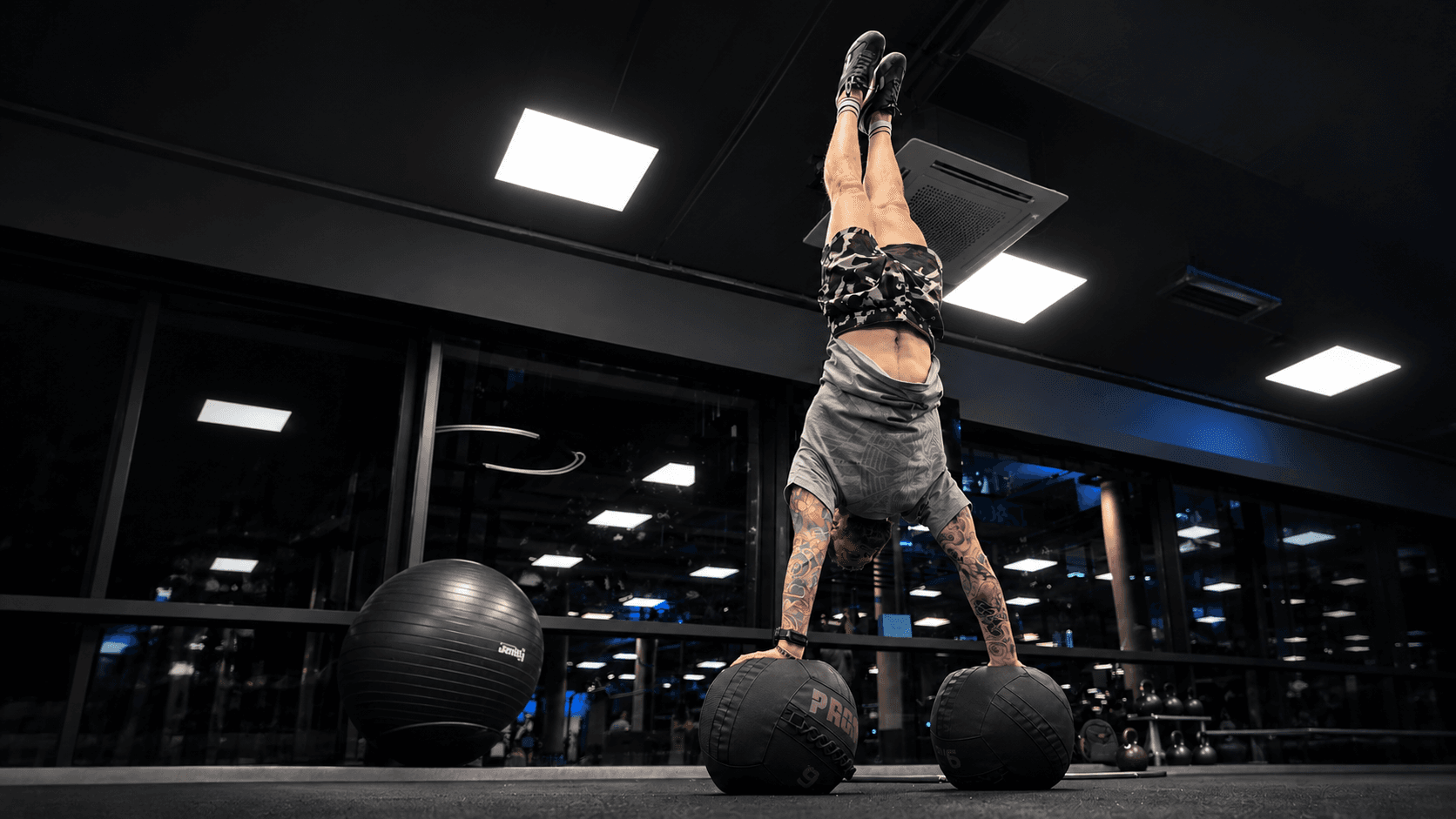
A handstand may look like a simple skill: turn upside down, straighten your body, and maintain your balance. But behind this apparent simplicity lies a complex interaction between your muscles, joints, and nervous system.
A handstand is not just a strength exercise. It's a skill that requires you to control your body in an unfamiliar position.
Let's explore what happens to your body during a handstand, which physical abilities you can develop, and why strong arms alone are not enough to achieve a good handstand.
Which Muscles Work During a Handstand?
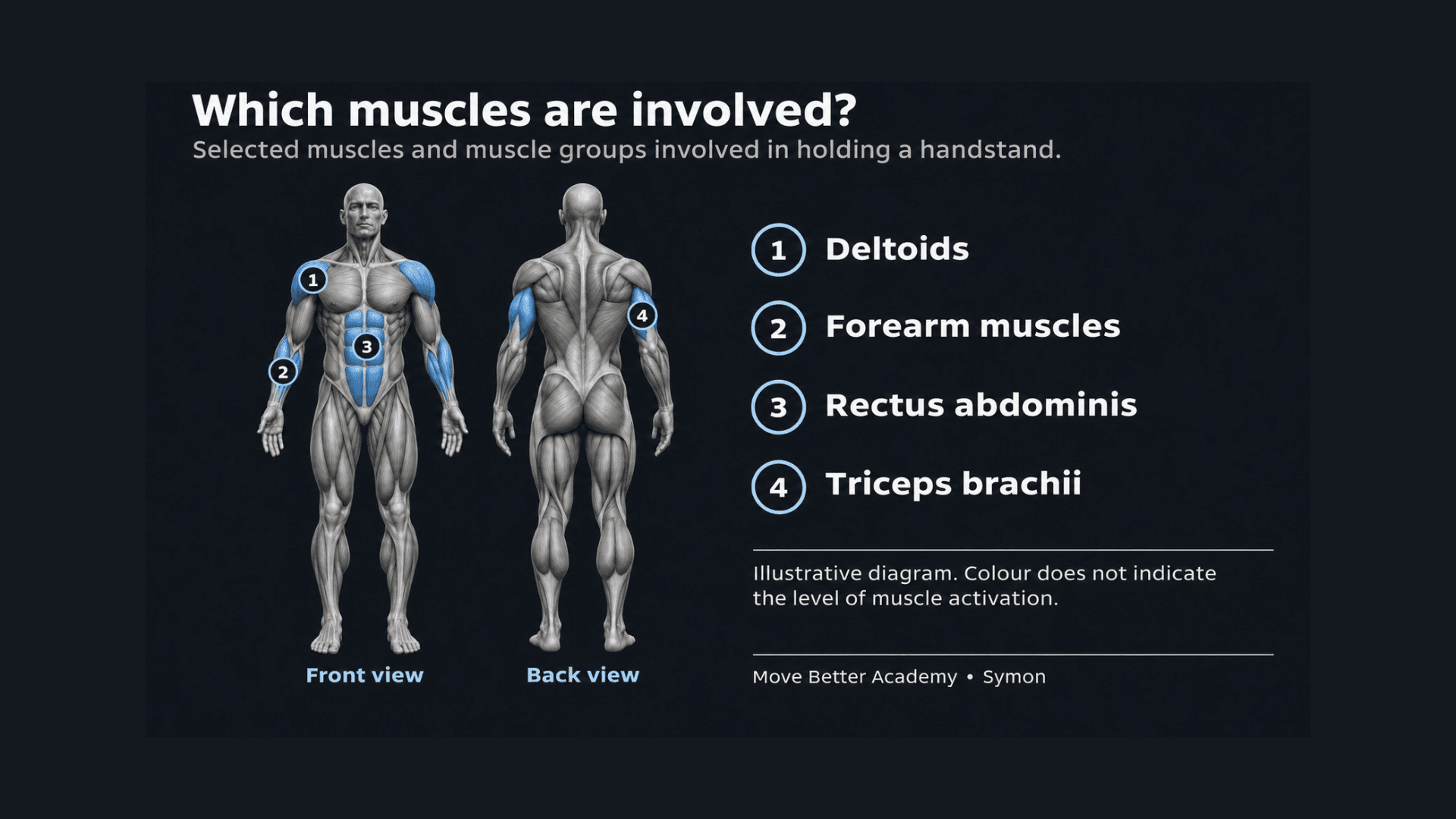
During a handstand, your upper limbs bear most of your body weight, while the muscles of your core and other parts of your body help maintain a stable position.
Several muscle groups play particularly important roles:
Deltoid muscles — help maintain shoulder joint positioning and stabilize your body while supporting your weight on your hands.
Forearm muscles — control your hands and fingers, allowing you to make small balance corrections.
Triceps brachii — help maintain elbow extension and support your arms under load.
Abdominal and core muscles — help control the relationship between your rib cage, spine, and pelvis.
Muscles throughout your back, shoulder girdle, hips, and legs are also involved.
The key is not to contract every muscle as hard as possible, but to coordinate them effectively.
Why Is Shoulder Blade Control So Important?
Many beginners focus on straightening their arms and lifting their legs overhead, but often underestimate the importance of shoulder blade control.
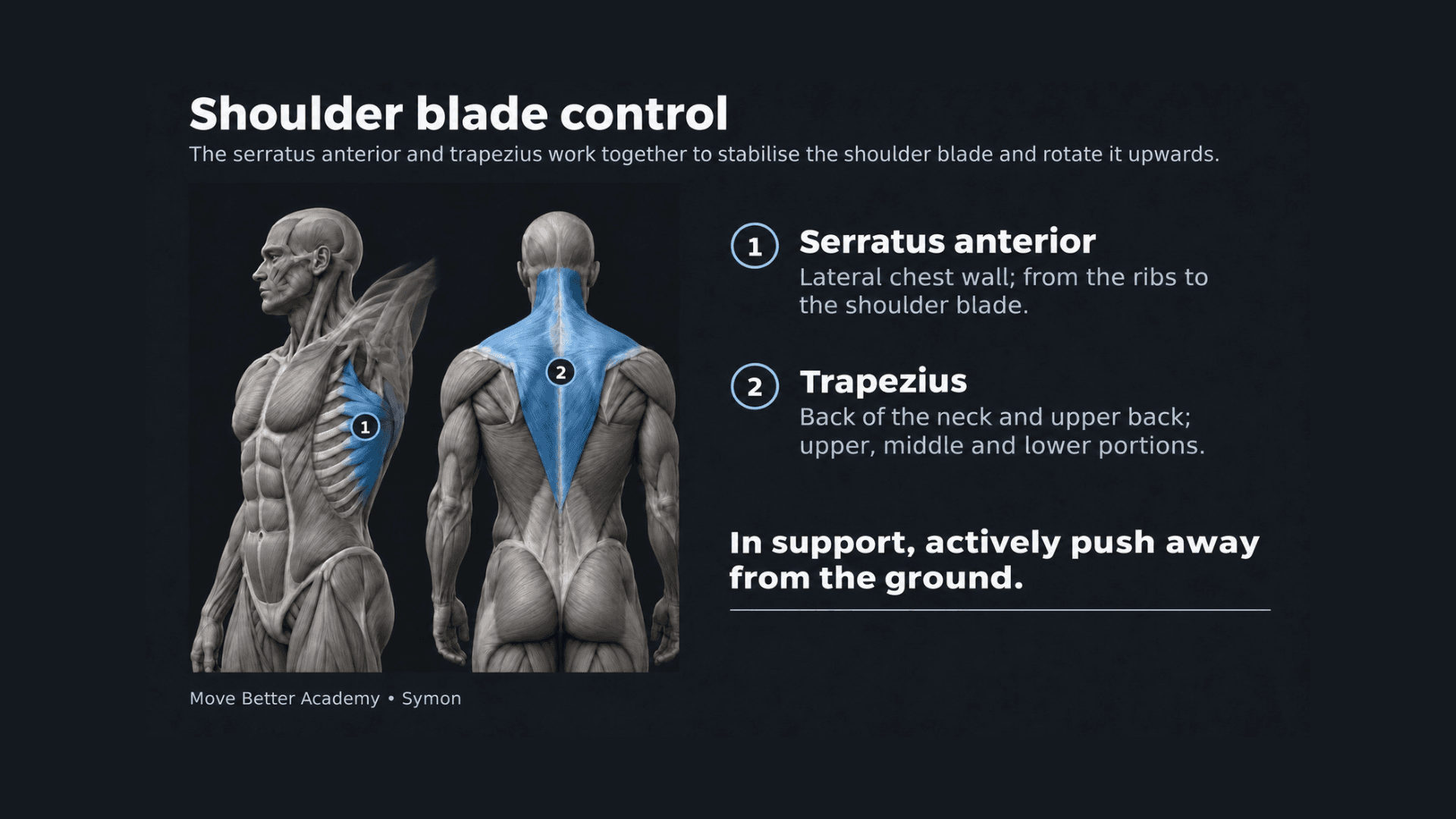
Two muscles play particularly important roles in maintaining a stable support position:
Serratus anterior — helps stabilize the scapula against the rib cage and contributes to its upward rotation.
Trapezius — its different regions work together to move and stabilize the scapula.
These muscles cooperate with other muscles of the shoulder complex to help maintain a stable body position.
Simply placing your hands on the floor is not enough. You need to learn how to actively engage your shoulder girdle and control the support.
How Do Your Fingers Help Maintain Balance?
When you're standing on your feet and your body starts leaning slightly forward or backward, the pressure under your feet changes to help restore balance.
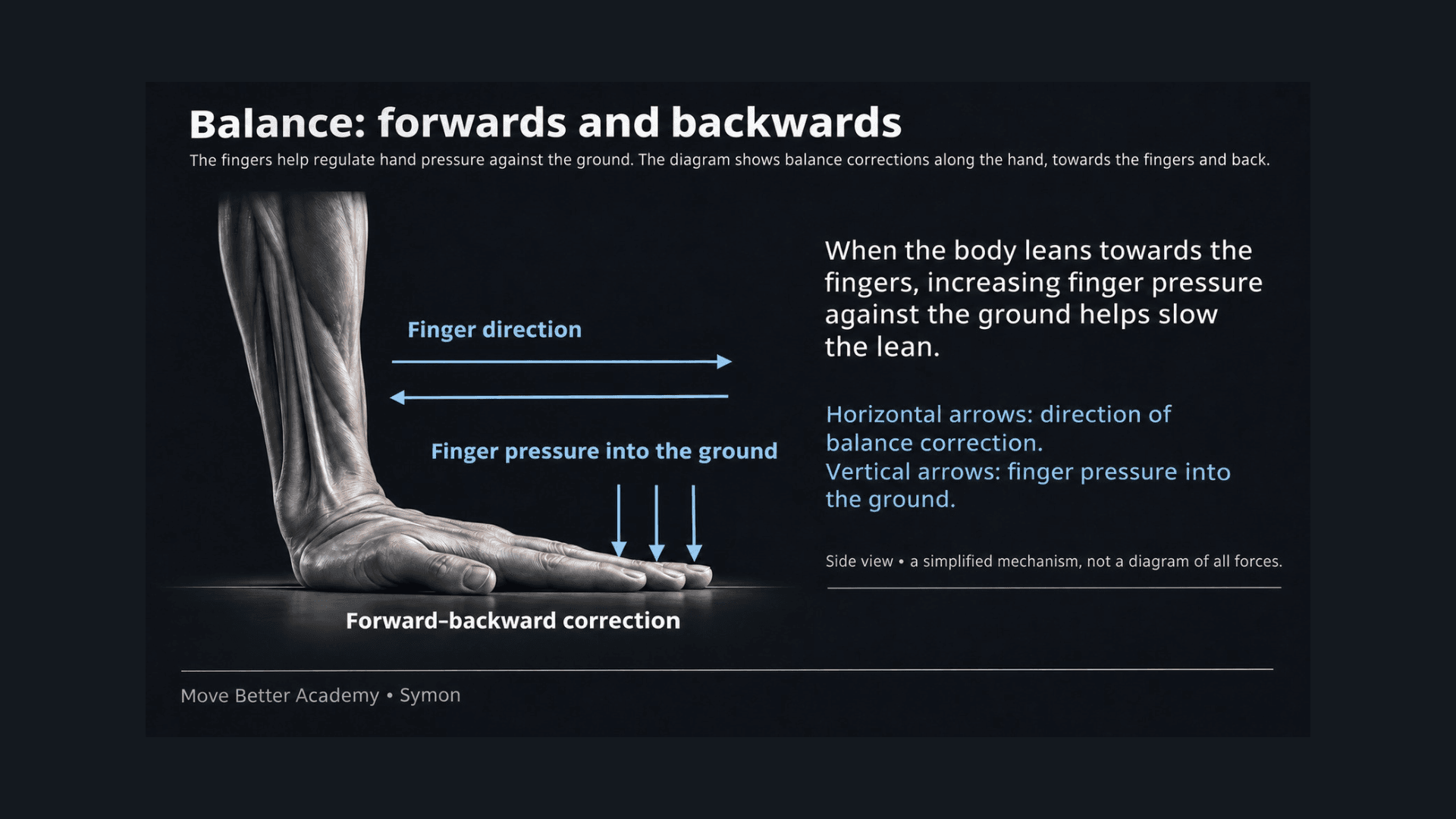
A similar mechanism operates during a handstand, but your hands and wrists play the main role in making small corrections.
When your body starts leaning toward your fingers, increasing fingertip pressure against the floor helps slow down the movement.
By changing the distribution of pressure between your fingers and palms, you can make small, precise balance adjustments.
This mechanism is known as the wrist strategy.
When the body moves further away from balance, movements at the shoulders and hips may also contribute to recovery.
A successful handstand therefore depends not only on strength, but also on your ability to generate the right corrective forces at the right moment.
What Does Your Nervous System Learn?
During a handstand, your nervous system continuously processes information about your body's position and movement.
It relies on several sources:
Vision — helps you orient yourself in your surroundings.
Proprioception — allows you to sense joint positions, body movements, and muscular effort.
The vestibular system — helps you detect the position and movement of your head relative to gravity.
Based on this information, your nervous system coordinates the muscular responses needed to maintain balance.
Regular technical practice can gradually improve the coordination and precision of your movements.
You're not just learning to stand upside down — you're learning to control your balance in a new body position.
Does Handstand Training Develop Strength and Coordination?
A handstand places significant demands on the muscles of your upper limbs, shoulder girdle, and core.
Regular practice may help develop strength, muscular endurance, and the ability to maintain a stable support position.
However, holding a handstand and developing maximal muscular strength are not the same thing. Significant improvements in maximal strength generally require additional strength training with appropriate progressive overload.
Beyond strength, handstand training allows you to develop and refine several movement skills:
Coordination — the ability to synchronize movements of your arms, shoulders, torso, and legs.
Spatial orientation — the ability to control your body in an unfamiliar position.
Movement precision — making small corrections to maintain balance.
Strength and stability — the ability to maintain controlled support on your hands.
It's important to understand that improving one specific movement skill does not automatically improve every other physical ability.
A Handstand Is Not a Universal Solution
Despite the benefits of training, a handstand is not a universal way to improve physical fitness or solve every health-related problem.
On its own, it does not guarantee better posture, relief from back pain, weight loss, or increased muscle mass.
Results depend on your starting fitness level, training load, consistency, and recovery.
A handstand is primarily a movement skill that requires progressive learning and practice.
How Can You Start Learning Safely?
Instead of trying to hold a handstand for as long as possible from the very beginning, start by gradually preparing your body for weight-bearing exercises.
1. Prepare your wrists and shoulders. Develop the necessary mobility, strength, and tolerance for supporting your body weight.
2. Master basic support positions. Learn to transfer your weight onto your hands, maintain stability, and control your torso position.
3. Progress gradually to inverted positions. Use appropriate preparatory exercises and stable support surfaces.
4. Learn how to exit a handstand safely. This is essential before attempting to balance independently. If you lack experience, practice with assistance from a qualified coach.
Do not attempt to copy advanced skills performed by professional athletes without adequate preparation.
Control Matters More Than Seconds
Beginners often measure progress only by how long they can hold a handstand: 5, 10, or 30 seconds.
But hold duration is only one indicator.
It's equally important to consider how accurately you enter a handstand, maintain a stable position, control small deviations, and exit safely.
Sometimes a few seconds of high-quality independent balance demonstrate more technical progress than a longer hold with repeated loss of control.
Control first. Duration second.
Want to Learn How to Handstand?
At Move Better Academy, handstand training is divided into four progressive levels:
LEVEL 1 — FOUNDATION — basic hand support, strength, and body control.
LEVEL 2 — INVERSION — learning inverted positions.
LEVEL 3 — WALL CONTROL — developing technique and stability with wall support.
LEVEL 4 — FREESTANDING — independent handstand entries and balance training.
Each level helps you progressively develop the skills needed for the next stage.
A handstand is more than a body position. It's a process of developing strength, coordination, and precise movement control.
About the author